
Etobicoke Independent Tesla Diagnostics Since 1999
Tesla Battery Degradation | Range Loss & Battery Health Toronto
Tesla battery degradation is real, but most unexpected range loss is not degradation. Understanding the difference — normal aging vs sudden range drop vs active fault — determines whether you need diagnosis, a calibration, or nothing at all. Radman Auto Repair in Etobicoke explains it properly for Toronto and GTA Tesla owners.
Serving Etobicoke Since 1999
Model 3, Y, S & X
No Guesswork
Toronto & GTA
Tesla battery degradation is normal and gradual over years and high mileage. But sudden range loss — the car that showed 420 km last month and now shows 320 km — is almost never true degradation. It is usually a BMS recalibration event, a charging behaviour artefact, a thermal management fault, a maximum charge level reduced restriction, or a 12V battery fault generating phantom BMS codes. The distinction matters enormously — true degradation cannot be reversed, but most of these causes can be addressed diagnostically.
For Toronto and GTA Tesla owners, there is an additional layer: Ontario winter conditions cause real, temporary range reduction of 30–40% that has nothing to do with battery health. A Model 3 that delivered 450 km per charge in September may display 300 km in January — and recover fully in April. Confusing seasonal range variation with degradation leads owners to unnecessary worry and unnecessary diagnostics.
The goal at Radman is to determine which category your range concern falls into — normal aging, seasonal variation, calibration artefact, support-system fault, or genuine cell capacity loss — before any recommendation is made. The exact charging behaviour, the rate of change, whether it happened suddenly or gradually, and what the BMS fault data shows are all part of building that picture. Those details matter. Bring them.
Normal Degradation vs Range Loss That Needs Diagnosis
This is the most important distinction on this page. Not all range loss is the same, and understanding which category applies determines whether the correct response is to do nothing, change charging habits, book a diagnostic, or seek pack-level evaluation.
✓ Normal — Monitor, No Diagnosis Required
- Gradual range reduction over years — 1–3% per year in typical use
- Range estimate that has drifted 5–10% lower over 2–3 years of ownership
- Range displayed is lower in January than in September (seasonal variation)
- Range estimate varies by 10–15% based on recent driving style (highway vs city)
- Range recovers partially after a full charge cycle following months of 80% charging
- No warning messages, no charge restrictions, no BMS fault codes
- Consistent Supercharging speed, no throttling at expected charge levels
⚠ Needs Diagnosis
- Sudden range drop of 15%+ with no obvious seasonal or driving cause
- Range that does not recover in spring after winter low readings
- A Maximum Charge Level Reduced warning limiting charge below expected level
- BMS fault codes referencing cell module voltages or battery health
- Supercharger speed dramatically lower than the vehicle's rated peak for no apparent reason
- Battery Needs Service message appearing alongside range reduction
- Range that changes significantly day to day without a change in temperature or driving style
- Charging that stops well before the set limit with no warning
If your situation lands in the right column, proper BMS diagnostic data review — not an assumption about degradation — is the correct first step. Most of these symptoms are caused by something other than irreversible cell capacity loss.
What Actually Causes Range Loss on a Tesla
There are several distinct causes of reduced Tesla range, most of which are not true degradation. Understanding which one applies is what diagnosis resolves.
Genuine, permanent reduction in the amount of energy the cells can store. Caused by high cycle count, sustained high temperatures, frequent deep discharge, and repeated 100% charging. This is the only cause that is truly irreversible. It is also the least common cause of sudden range complaints — true degradation is gradual and takes years.
The BMS continuously updates its model of pack capacity based on observed charge and discharge behaviour. A full charge or full discharge cycle can force a recalibration that moves the displayed range estimate up or down — sometimes significantly. This is not degradation. Range may appear to have dropped 40 km overnight after a calibration cycle then partially recover. Controlled full charge-discharge cycles can improve BMS calibration accuracy.
The BMS has imposed a charge cap — the car will not charge to its set limit. This produces an apparent range reduction because the battery is not reaching full charge. The cause may be a 12V battery fault, a cooling system fault, a BMS error code, or a genuine cell concern. See the maximum charge level reduced page.
A failed coolant pump, stuck valve, low coolant level, or heat pump fault can prevent the battery from reaching optimal temperature for charging. The BMS throttles charge acceptance to protect cells that are too cold or too warm, resulting in lower state of charge and lower displayed range. See the battery cooling system problems page.
A failing 12V auxiliary battery can generate BMS fault codes that impose false charge restrictions, producing apparent range reduction without any actual change in HV pack health. This is a common misdiagnosis path. See the 12V battery failure page and the high voltage vs 12V battery page.
Charging exclusively to 80% for an extended period can cause the BMS's capacity model to drift, making displayed range estimates less accurate. A full charge to 100% (or a full discharge to near-zero followed by a 100% charge) can recalibrate the model. This is not degradation — it is an estimation artefact.
Cold ambient temperatures temporarily reduce available lithium-ion cell capacity and force the vehicle to spend energy heating the cabin and battery pack. A 30–40% winter range reduction in January/February GTA conditions is normal. Range recovers fully when temperatures rise. This is not degradation and requires no service.
Highway driving at 120 km/h consumes significantly more energy per kilometre than city driving at 50 km/h. A Tesla that was recently driven primarily on the 400-series highways will display a lower projected range than the same vehicle after a period of city driving. The BMS updates its range projection based on recent consumption — this is working as intended.
Ontario Winter Range: What's Normal, What Isn't
More Tesla owners in Toronto and the GTA contact Radman about range concerns in January and February than in any other months. Most of the time, what they are experiencing is a combination of real but temporary seasonal factors — not degradation, not a fault. Here is what the GTA winter actually does to Tesla range estimates and why.
Why Range Drops in Winter
Lithium-ion cells deliver less usable capacity at temperatures below 0°C — the chemistry is temperature-dependent. At −15°C a Tesla pack may be operating at 70–80% of its summer capacity, with the remainder temporarily unavailable. Additionally, cabin heating on models without a heat pump draws significant energy directly from the HV battery. The combination of reduced available capacity and high cabin heating load explains most of the winter range reduction GTA owners see.
Heat Pump vs Resistance Heating
Model Y and newer Model 3 vehicles have a heat pump that is 3–4x more efficient at converting electrical energy to heat than resistance heating. At temperatures above approximately −15°C, the heat pump significantly reduces the cabin heating energy penalty. Below −15°C the heat pump efficiency drops and resistance heating supplements it more heavily. This is why a heat pump Tesla loses less range in mild Ontario winters but still sees significant reduction in deep cold snaps.
Pre-Conditioning Matters
Pre-conditioning the cabin and battery while still plugged in — using scheduled departure or manual pre-conditioning via the app — substantially reduces winter range loss. When the car is pre-conditioned on shore power, it arrives at driving temperature without spending any stored energy. GTA owners who skip pre-conditioning because they park outdoors without charging are trading range for convenience in a way that compounds the winter reduction.
When to Be Concerned
Winter range reduction that is consistent, proportional (roughly 25–35% in deep cold), and recovers as temperatures rise in spring is normal. Range that does not recover by April or May, range that is lower in summer than it was the previous summer at the same temperatures, or range accompanied by a warning message or Supercharger throttling should be investigated. Those are the signals that separate seasonal variation from a developing battery issue.
Tesla Battery Degradation Rates: What to Expect
These are general reference ranges based on fleet data and independent studies. Individual results vary based on charging habits, climate, mileage, and model year. These figures represent normal operation — any range reduction significantly outside these ranges, or accompanied by warning messages, warrants investigation.
| Timeframe / Mileage | Expected Range Retention | Notes for Ontario Owners |
|---|---|---|
| Year 1 (0–30,000 km) | ~95–98% of original rated range | The steepest degradation curve is in year one as the BMS calibrates to the specific pack. Some owners see a 2–5% adjustment in the first months — this is often calibration, not capacity loss. |
| Years 2–3 (30,000–80,000 km) | ~90–95% of original rated range | Degradation curve flattens significantly. Winter range readings during this period should not be compared to summer readings — seasonal variation is larger than degradation at this stage. |
| Years 4–6 (80,000–160,000 km) | ~85–92% of original rated range | Normal territory for higher-mileage GTA commuter Teslas. Frequent Supercharging without intermediate Level 2 sessions accelerates degradation at this stage. |
| Years 7–10 (160,000–300,000 km) | ~80–88% of original rated range | High-mileage Teslas in this range are common in Toronto rideshare and high-commute use. Well-maintained packs with good charging habits remain functional and useful at these mileages. |
| Sudden drop at any mileage | Not consistent with normal degradation | A sudden 10%+ range drop at any point in the ownership timeline is not normal aging. It requires BMS fault data review, 12V evaluation, and thermal management inspection before conclusions are drawn. |
How Charging Habits Affect Displayed Range
This is one of the most misunderstood aspects of Tesla ownership. The range number on the touchscreen is not a direct measurement of pack capacity — it is a projection calculated by the BMS based on recent driving energy consumption and its current model of available capacity. Several charging behaviours cause this estimate to shift in ways that owners interpret as degradation.
Tesla recommends daily charging to 80–90% for longevity. This is good practice. However, if a vehicle charges exclusively to 80% for months without ever reaching 100%, the BMS develops a capacity model based only on the observed 80% window. This can cause displayed range at 100% (on the rare occasions the owner charges fully) to appear lower than expected. The BMS has not seen enough of the upper capacity range to model it accurately.
A full charge to 100% after a long period of 80% charging often causes owners to believe range has dropped — because the BMS recalibrates its full-charge estimate based on updated cell data. The recalibrated number is usually more accurate than the previous estimate. This is not degradation; it is the BMS correcting a drift in its model.
Frequent DC fast charging without intermediate Level 2 sessions tends to keep the BMS in a narrow state-of-charge window. Tesla recommends a full Level 2 charge session periodically to allow the BMS to see the full range of the pack's charge profile. Owners who Supercharge exclusively on long trips and rarely do a full home charge may see range estimate drift that self-corrects after a full Level 2 overnight charge.
Consistently keeping state of charge above 20% is good for battery longevity. But the BMS also benefits from occasionally seeing the full discharge curve to calibrate its low-end capacity estimate. An occasional discharge to 10–15% followed by a full Level 2 charge to 100% can improve BMS accuracy. This is a calibration practice, not a requirement — and should not be done repeatedly.
Unexpected range loss on your Tesla in Toronto, Etobicoke, Vaughan, or anywhere in the GTA? Call (416) 742-4521. We read the BMS data first and explain what is actually happening before recommending anything.
How Radman Approaches Tesla Battery Warnings
This is also why the battery cluster links into Radman's broader Tesla Mechanic Toronto, Tesla brake service, Tesla suspension diagnosis, and check engine and electrical diagnostics pages. A Tesla warning rarely lives in isolation.
For the full repair-vs-replacement picture, see the can a Tesla battery be repaired page. For specific charge restriction warnings, see the maximum charge level reduced page.
Related Tesla Battery Warning Pages
This page is part of Radman Auto Repair's Tesla battery warning and BMS diagnostic hub.
The main Tesla battery warning message and failure diagnostics hub for Toronto and Etobicoke.
Tesla Battery Warning Messages & Failure Diagnostics Toronto
Tesla battery warning messages, battery failure symptoms, charging errors and BMS diagnostics in Toronto and Etobicoke for Model 3, Model Y, Model S and Model X owners.
Tesla Battery Failure Symptoms Toronto
Tesla battery failure symptoms explained for Toronto owners including range loss, charge limit warnings, reduced power and charging restrictions.
Tesla Battery Needs Service Warning Toronto
Tesla battery needs service warning explained for Model 3, Model Y, Model S and Model X owners near Toronto and Etobicoke.
Tesla Maximum Charge Level Reduced Warning Toronto
Tesla maximum charge level reduced warning explained including range loss, reduced charge limits, BMS alerts and when to book a diagnostic.
Tesla Unable To Charge Diagnosis Toronto
Tesla unable to charge warning, charging fault, reduced charge limit and BMS battery alert diagnosis for Toronto and Etobicoke Tesla owners.
Tesla Reduced Power Warning Diagnosis Toronto
Tesla reduced power and acceleration warning diagnosis for Model 3, Y, S and X including battery, cooling, drive unit and low voltage system faults.
Tesla Service Links That Matter
Tesla owners often arrive for one problem and discover another related issue. These Radman resources keep the full service path connected.
The main Tesla service hub for Model 3, Model Y, Model S and Model X owners in the GTA.
Tesla Brake Service
Brake cleaning, corrosion, rotor and friction brake service for EVs that rely heavily on regenerative braking.
Tesla Suspension & Wheel Bearing Repair
For humming, clunking, vibration, ball joint, control arm and wheel bearing symptoms.
Tesla Brake Rust & Corrosion Repair
Tesla brake corrosion diagnosis and service with EV-specific maintenance in mind.
Tesla Battery Degradation Diagnosis — Toronto & GTA
Radman Auto Repair is at 321 Rexdale Blvd #4 in Etobicoke, near the 401 and 427 interchange. Range concerns spike across the GTA every January and February — and the vast majority trace back to seasonal variation, calibration drift, or a repairable support-system fault rather than true pack degradation. Tesla owners from across the city and 905 come specifically to get a clear, evidence-based answer before worrying further.
Home base. Many local owners arrive in January with winter range concerns that resolve with a calibration explanation.
Lakeshore Tesla owners — often high-mileage commuters — come for range trend evaluation to distinguish normal aging from a developing fault.
Allen Road or 400 to 401 west. North York owners with high-frequency Supercharging patterns sometimes see calibration drift that mimics degradation.
Hwy 400 south. Vaughan Tesla owners doing 400-series highway commutes notice range projection drops first — the BMS adjusts to highway consumption patterns.
Easy 400 south access. Similar high-highway usage pattern to Vaughan — range estimates lower than city-driving equivalents.
401 east or 427 north. Large Tesla fleet with mixed highway and city driving produces the full range of BMS calibration variability.
Queen Street east or 427. Brampton owners often see the first apparent range drop after the first Ontario winter — usually seasonal, not degradation.
404 or 400 to 401 west. North-GTA owners comparing year-over-year range sometimes confuse BMS recalibration events with capacity loss.
Gardiner west to 427 north. Downtown owners with city-only driving patterns sometimes see range estimates drop significantly when they first take the car on a highway — the BMS updates its consumption model.
Not sure if your Tesla's range change is normal? Call (416) 742-4521. We can often help assess the likely cause based on when the change appeared and what the charging behaviour has been, before you make the trip.
Frequently Asked Questions
How much Tesla battery degradation is normal?
Normal degradation is slow and gradual — roughly 1–3% per year under typical ownership conditions. Most Tesla owners see around 10–15% total range reduction over 150,000–200,000 km. The curve is steepest in year one as the BMS calibrates to the specific pack, then flattens significantly. Normal degradation does not produce warning messages, does not cause sudden drops, and does not trigger BMS fault codes. If you are seeing any of those, the cause is more likely a support-system fault than true capacity loss.
Is sudden range loss the same as normal degradation?
No — these are fundamentally different. Normal degradation takes years and tens of thousands of kilometres. Sudden range loss — a Tesla that showed 400 km last week and now shows 310 km — is almost never degradation. It is most commonly a BMS recalibration event, a charge level restriction from a fault code, a thermal management fault, or a 12V battery-induced phantom BMS restriction. Diagnosis reads the BMS data and determines which cause is actually present before any pack-level conclusions are drawn.
Can charging habits affect the range displayed by a Tesla?
Yes, significantly. The displayed range is a BMS projection based on recent consumption and its current capacity model — not a direct measurement. Charging exclusively to 80% for months can cause the model to drift, making the 100% estimate less accurate. Frequent highway driving causes the model to project lower range than city driving. A full charge cycle or a varied charge session can recalibrate the model. None of these represent true degradation — they are estimation artefacts that are normal and largely self-correcting.
Why does my Tesla show so much less range in winter?
Winter range reduction is real, expected, and temporary. At −10°C to −25°C — common across the GTA from December through February — lithium-ion cells deliver less usable capacity, and significant energy is needed to heat the cabin and battery. A 25–40% range reduction in deep cold is normal for most Tesla models. Vehicles with a heat pump (Model Y, newer Model 3) fare better in mild cold than those with resistance heating only. Range recovers fully as temperatures rise in spring. If your range has not recovered by May, that warrants investigation.
What actually causes sudden range reduction on a Tesla?
In order of frequency for Toronto and GTA owners: a BMS recalibration event triggered by a full charge or full discharge cycle; a Maximum Charge Level Reduced fault code imposing an invisible charge cap; a 12V battery fault generating phantom BMS restrictions; a thermal management fault limiting charge acceptance; and genuine BMS-detected cell module degradation or imbalance. The first three are far more common than the last. BMS fault data review, 12V evaluation, and thermal system inspection identify the actual cause.
Is every Tesla battery warning a full battery replacement?
No. Many range-related and battery-related warnings are caused by the 12V battery, charging equipment, thermal management, coolant flow, wiring, sensors, or BMS calibration state. Diagnosis separates a genuine high voltage pack problem from a support-system fault. See the can a Tesla battery be repaired page for the full repair-vs-replacement framework.
Does Radman service Tesla owners from Toronto and the GTA?
Yes. Radman Auto Repair at 321 Rexdale Blvd #4 in Etobicoke serves Tesla owners from Toronto, Mississauga, Brampton, Vaughan, Woodbridge, Concord, North York, York Mills, Mimico, Richmond Hill, Markham, Rexdale, and the wider GTA. Our location near the 401 and 427 interchange is accessible from most parts of the city and the inner 905.
Can Radman diagnose Tesla battery and BMS warnings?
Radman Auto Repair handles Tesla warning-message diagnosis, BMS fault data review, 12V battery evaluation, charging system inspection, thermal management diagnosis, and related EV support-system troubleshooting. True high voltage pack repair may require Tesla or a qualified high-voltage battery specialist depending on the confirmed fault — and we will tell you clearly if that is the case.





Cities We Serve
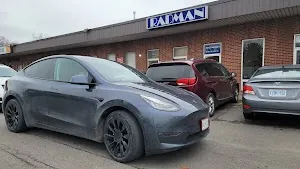
Located in Rexdale, Radman Auto Repair serves Tesla owners across Etobicoke, Toronto, Mississauga, Brampton, Vaughan, Woodbridge, Concord, North York, York Mills, Mimico, Richmond Hill, Markham, and the GTA for Tesla battery degradation, range loss diagnosis, BMS warnings, and all other Tesla service needs.
| Toronto, Ontario | Etobicoke, Ontario | Mississauga, Ontario | Brampton, Ontario |
| Vaughan, Ontario | Richmond Hill, Ontario | Markham, Ontario | Weston, Ontario |