
Etobicoke Independent Tesla Diagnostics Since 1999
Tesla Maximum Charge Level Reduced Warning Explained
The Tesla maximum charge level reduced warning is one of the most misunderstood messages in the cluster — because it is often confused with normal battery degradation when it is actually a BMS-imposed charge cap that can have a repairable, non-pack cause. Radman Auto Repair in Etobicoke helps Toronto and GTA Tesla owners understand which situation they are actually in before any expensive decisions are made.
Serving Etobicoke Since 1999
Model 3, Y, S & X
No Guesswork
Toronto & GTA
A Tesla maximum charge level reduced warning means the Battery Management System has decided the battery should not be charged above a certain threshold — and that threshold is lower than the owner's set charge limit. Charging stops at the BMS ceiling, not at the set limit, and the message appears to explain why.
The most important thing to understand about this message is that it is not the same as battery degradation. Normal degradation reduces the total capacity of the battery over years of use — the pack can physically hold less charge. A BMS charge cap is different: the BMS has decided to limit charging based on a detected condition, and that condition may be a support-system fault (a failing 12V battery, a thermal management problem, a charging equipment anomaly) rather than actual cell deterioration.
A maximum charge level reduced message that appeared overnight after a specific charging session, or that produced a large sudden reduction in displayed range, is far more likely to be a BMS fault cap than genuine degradation. A BMS cap caused by a 12V battery fault can disappear entirely with a $300–$500 12V replacement — no HV pack work required. That is why diagnosis comes before conclusions. See the BMS_a079 page for the specific code behind this message, and the battery degradation page for the degradation context.
Degradation vs BMS Fault Cap — The Critical Distinction
These two situations produce similar symptoms — less range, lower charge ceiling — but have very different causes, urgency levels, and resolution paths. The signals below help identify which you are dealing with before diagnosis begins.
Consistent With Normal Degradation
- Range at "full" charge has been gradually declining over many months or years — not a sudden change
- The car reaches the owner's set charge limit (e.g. 90%) — it just shows less range at that level than it used to
- No explicit "Maximum Charge Level Reduced" message — or the message appeared only at a much later stage of ownership
- The rate of decline is consistent with the vehicle's age and usage — roughly 1–2% capacity per year is typical for a well-managed Tesla
- No specific charging event preceded the noticeable change
- Consistent across all chargers and conditions — not linked to a particular charging location or session
Consistent With BMS Fault Cap — Get Diagnosis
- Change was sudden — the car previously charged to 90% without issue, and now stops at 70–75% with the message
- A specific charging event preceded the change — a Supercharger session, a new cable, cold weather overnight charging
- The "Maximum Charge Level Reduced" message appeared explicitly on the touchscreen
- The change coincided with a BMS_a079 or BMS_a068 code on the touchscreen
- The car also shows additional warnings: Battery Needs Service, Unable to Charge, or Reduced Power alongside the charge restriction
- Vehicle is a relatively young model (under 4–5 years) or has below-average mileage — large sudden range loss in a newer vehicle is rarely degradation
Both situations are worth understanding in detail. For the degradation picture — how much capacity loss is normal and when does it become a concern — see the battery degradation page. For the BMS fault code mechanism behind the explicit charge reduction message, see the BMS_a079 page.
Range Loss Patterns — What They Point Toward
How range loss manifests is as diagnostically useful as the message itself. These patterns are the most common presentations in GTA Tesla ownership.
The car charged to 90% with 400 km displayed on Monday. Tuesday morning after the same charge it shows 320 km. Nothing changed between the two sessions except a Supercharger stop or a cold overnight outdoor park.
Likely BMS fault cap — book diagnosis, 12V and thermal first
At purchase the car showed 450 km at 90% charge. Now it shows 400 km at 90% charge after two years. No explicit warning message. The owner simply noticed the dashboard number is lower.
Likely normal degradation — within expected range for the vehicle age
The owner set the charge limit to 90%. The car stops at 72% with "Maximum Charge Level Reduced" on screen. The displayed range at 72% is lower than what 90% used to show. The owner initially thinks range has dropped but the car never reached 90%.
Classic BMS cap — this is BMS_a079 in practice. See the BMS_a079 page
The car reaches 90% as set, but the displayed range is lower than expected. This is different from the cap pattern above — the car did reach the set limit. The displayed range is lower because of actual capacity reduction, not a charging stop.
Likely degradation — or a BMS calibration issue after a partial discharge cycle
The car shows normal range in spring through fall but significantly less range in January and February. No persistent warning message.
Normal winter range reduction — Tesla batteries operate less efficiently in cold. Not a fault. Pre-conditioning reduces this.
Range dropped significantly, the maximum charge level reduced message appeared, and BMS codes or a Battery Needs Service message also appeared — all around the same time.
Active BMS fault condition — structured diagnostic needed promptly. See BMS error codes and battery needs service
What Causes the Maximum Charge Level Reduced Message
These are the hardware and system causes that produce the BMS charge cap behind this message, ordered from most repairable and most likely non-pack, to least common.
A failing 12V battery disrupts BMS communication during charging. The BMS receives incomplete data and imposes a charge restriction as a protective response. A 12V-induced maximum charge level reduced warning is one of the most resolution-satisfying diagnoses in the cluster — the restriction clears with a 12V battery replacement. In GTA winter, overnight outdoor parking depletes the 12V, and a charging session the following morning can trigger the cap. See the 12V battery failure page.
If the coolant pump underperformed, a valve was stuck, or coolant level was low during the charge session that triggered the cap, the battery reached a temperature the BMS considers worth restricting against. The cap remains even after the temperature normalises — the underlying hardware fault needs to be repaired for the restriction to clear. See the battery cooling system problems page.
A Supercharger stall that delivered abnormal current, a damaged charging cable, or a charge port communication error can produce an abnormal charging profile that the BMS logs as a charge restriction trigger. If the cap appeared immediately after a specific Supercharger visit or a new cable was introduced, the charging equipment is part of the investigation. See the unable to charge page.
When individual cell modules within the HV pack develop voltage imbalances or reach a state-of-health level the BMS considers worth protecting against, the BMS imposes a charge cap to prevent overcharging the weaker cells. This is a pack-level cause — but it requires confirmation through BMS fault data and cell voltage data before any pack-level conclusion is drawn. It is the last cause to be confirmed, not the first.
In some cases the BMS recalibrates its capacity model after a series of partial charge-discharge cycles in a way that produces a temporary range reduction without a genuine hardware fault. A full charge-discharge cycle (charge to 100%, then drive to near-zero) has sometimes corrected this pattern — but should only be attempted after hardware causes are ruled out.
Consistently charging to 100% over an extended period allows the BMS to observe cells operating at the top of their voltage range. A proactive charge cap may be applied as a protective response to this charging pattern, particularly in older vehicles. Reducing the daily charge limit to 80–90% and avoiding regular 100% charges is recommended for daily-use vehicles.
How Radman Approaches Tesla Battery Warnings
This is also why the battery cluster links into Radman's broader Tesla Mechanic Toronto, Tesla brake service, Tesla suspension diagnosis, and check engine and electrical diagnostics pages. A Tesla warning rarely lives in isolation.
Tesla maximum charge level reduced in Toronto, Etobicoke, Vaughan, or the GTA? Call (416) 742-4521. Tell us whether the change was sudden or gradual — that single detail shapes the entire diagnostic approach.
Related Tesla Battery Warning Pages
This page is part of Radman Auto Repair's Tesla battery warning and BMS diagnostic hub.
Tesla battery warning messages, battery failure symptoms, charging errors and BMS diagnostics for Toronto and GTA Tesla owners.
Tesla Battery Failure Symptoms Toronto
Tesla battery failure symptoms explained including range loss, charge limit warnings, reduced power and charging restrictions.
Tesla Battery Needs Service Warning Toronto
Tesla battery needs service warning explained for Model 3, Model Y, Model S and Model X owners near Toronto and Etobicoke.
Tesla Unable To Charge Diagnosis Toronto
Tesla unable to charge warning, charging fault, reduced charge limit and BMS battery alert diagnosis for Toronto and Etobicoke Tesla owners.
Tesla Reduced Power Warning Diagnosis Toronto
Tesla reduced power and acceleration warning diagnosis for Model 3, Y, S and X.
Tesla BMS Error Codes Explained Toronto
Tesla BMS error codes explained for owners seeing battery management system alerts, charge limits, reduced power or high voltage battery warnings.
Tesla Service Links That Matter
Tesla owners often arrive for one problem and discover another related issue. These Radman resources keep the full service path connected.
The main Tesla service hub for Model 3, Model Y, Model S and Model X owners in the GTA.
Tesla Brake Service
Brake cleaning, corrosion, rotor and friction brake service for EVs that rely heavily on regenerative braking.
Tesla Suspension & Wheel Bearing Repair
For humming, clunking, vibration, ball joint, control arm and wheel bearing symptoms.
Tesla Brake Rust & Corrosion Repair
Tesla brake corrosion diagnosis and service with EV-specific maintenance in mind.
Tesla Maximum Charge Level Diagnosis — Toronto & GTA
Radman Auto Repair is at 321 Rexdale Blvd #4 in Etobicoke, near the 401 and 427 interchange. Maximum charge level reduced is one of the most common Tesla concerns in the GTA — the Ontario climate creates the thermal and 12V conditions that most frequently trigger BMS charge caps, and the Supercharger corridors on the 400-series produce their share of charging-event-triggered restrictions. Many of these cases resolve without any HV pack work once the actual cause is found.
Home base. BMS cap after a cold-weather charging session or 12V depletion overnight are the most common local presentations.
Lakeshore outdoor parking — 12V depletion followed by a morning charging session is a reliable trigger for maximum charge level reduced in winter.
Allen Road or 400 to 401 west. Maximum charge level caps appearing after 400-series Supercharger sessions are common in North York ownership.
Hwy 400 south. Vaughan Tesla owners arrive with maximum charge reduced after highway Supercharger sessions more than any other GTA area.
400 south. Similar Supercharger-session trigger pattern to Vaughan — the cap is frequently resolved with 12V or thermal management repair.
401 east or 427 north. Mississauga maximum charge level cases frequently trace to 12V faults in outdoor-parked winter vehicles.
Queen Street east or 427. Brampton Tesla owners with maximum charge reduced are often arriving after the message appeared following a specific Supercharger trip.
404 or 400 to 401 west. North-GTA owners with maximum charge level reduced frequently arrive seeking a second opinion before agreeing to pack-level work quoted elsewhere.
Gardiner west to 427 north. Downtown Tesla owners with maximum charge reduced from condo outdoor parking — 12V depletion is the most common root cause in this population.
Tesla maximum charge level reduced? Call (416) 742-4521. Tell us whether the change was sudden or gradual, and whether it appeared after a specific charging session — those two questions let us point you toward the likely cause before you make the trip.
Frequently Asked Questions
What does maximum charge level reduced mean on a Tesla?
It means the BMS has imposed an invisible charge ceiling lower than the owner's set limit — the battery will not accept charge above that internal threshold. Charging stops and the message appears when the cap is reached. The cap is a BMS decision based on a detected condition: cell voltage behaviour, a thermal event, a 12V battery fault during a charge session, or a charging equipment anomaly. It is distinct from normal degradation, which reduces total capacity gradually. A sudden maximum charge level reduced message after a specific charging event is far more likely to be a BMS fault cap than degradation.
Why will my Tesla not charge to its previous maximum?
The answer depends on whether the change was gradual or sudden. A gradual reduction in displayed range over many months — the car still reaches the set charge limit but shows less range — is consistent with normal degradation. A sudden drop, particularly one accompanied by the "Maximum Charge Level Reduced" message and charging stopping below the set limit, is consistent with a BMS fault cap rather than degradation. The BMS fault cap can be caused by a 12V battery fault, a thermal management fault, or a charging equipment anomaly — all of which are potentially resolved without HV pack work.
Can maximum charge level reduced be caused by a 12V battery fault?
Yes. A 12V battery fault is the most commonly resolved cause of a maximum charge level reduced warning in GTA Tesla ownership. The 12V powers BMS communication during charging — when voltage drops below operating threshold, the BMS receives corrupted data and imposes a charge restriction. In Ontario winter, overnight outdoor parking depletes the 12V through BMS wake cycles, and the charging session that follows can trigger the cap. A 12V replacement resolves the fault entirely in many cases. See the 12V battery failure page.
How do I tell if maximum charge level reduced is degradation or a fault?
Three signals help distinguish them. First, sudden vs gradual — a sudden large reduction after a specific charging event is more consistent with a BMS fault cap; a slow monthly reduction over years is more consistent with degradation. Second, does the car reach the set limit — if the car stops at 70% when set to 90%, that is a BMS cap; if it reaches 90% but shows less range than before, that is more consistent with capacity reduction. Third, does the explicit message appear — a BMS fault cap typically generates the "Maximum Charge Level Reduced" message; gradual degradation usually does not until a significant threshold is crossed.
What is the connection between maximum charge level reduced and BMS_a079?
BMS_a079 is the BMS fault code that produces the maximum charge level reduced and "Unable to Charge — Maximum Charge Level Reached" messages. The code is the back-end log entry; the touchscreen message is what the owner sees. They describe the same condition. The causes, diagnostic process, and resolution paths are the same. If you are seeing the message and want the code-level detail, the BMS_a079 page covers it fully.
Is every Tesla battery warning a full battery replacement?
No. Maximum charge level reduced in particular is one of the warnings most often caused by the 12V battery, thermal management hardware, or charging equipment — all of which can be repaired without any HV pack work. A 12V battery fault that caused a BMS charge cap is one of the least expensive charging warnings in the cluster to resolve. See the can a Tesla battery be repaired page.
Does Radman service Tesla owners from Toronto and the GTA?
Yes. Radman Auto Repair at 321 Rexdale Blvd #4 in Etobicoke serves Tesla owners from Toronto, Mississauga, Brampton, Vaughan, Woodbridge, Concord, North York, York Mills, Mimico, Richmond Hill, Markham, Rexdale, and the wider GTA. Our location near the 401 and 427 interchange is accessible from most parts of the city and the inner 905.
Can Radman diagnose Tesla battery and BMS warnings?
Radman Auto Repair handles Tesla warning-message diagnosis, BMS fault code review, 12V battery evaluation, thermal management inspection, charging system diagnosis, and related EV support-system troubleshooting. True high voltage pack repair may require Tesla or a qualified high-voltage battery specialist depending on the confirmed fault — and we will tell you clearly if that is the case.





Cities We Serve
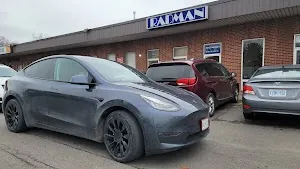
Located in Rexdale, Radman Auto Repair serves Tesla owners across Etobicoke, Toronto, Mississauga, Brampton, Vaughan, Woodbridge, Concord, North York, York Mills, Mimico, Richmond Hill, Markham, and the GTA for maximum charge level reduced diagnosis, Tesla battery warnings, and all other Tesla service needs.
| Toronto, Ontario | Etobicoke, Ontario | Mississauga, Ontario | Brampton, Ontario |
| Vaughan, Ontario | Richmond Hill, Ontario | Markham, Ontario | Weston, Ontario |