
Etobicoke Independent Tesla Diagnostics Since 1999
Tesla BMS Error Codes Explained | Battery Management System Alerts
Tesla BMS error codes — BMS_a067, BMS_a068, BMS_a079 and related Battery Management System alerts — explained for Toronto, Etobicoke, and GTA Tesla owners. Every code has a specific meaning, and not all of them point to an expensive high voltage pack problem. Radman Auto Repair diagnoses what the code actually indicates before recommending anything.
Serving Etobicoke Since 1999
Model 3, Y, S & X
No Guesswork
Toronto & GTA
Tesla BMS error codes come from the Battery Management System — the software layer that continuously monitors the high voltage pack, controls charging, manages thermal conditions, and communicates with every other system in the vehicle. When the BMS detects a value outside its acceptable parameters, it logs a fault code and typically displays a warning on the touchscreen.
Tesla owners often search the exact code shown on screen — BMS_a067, BMS_a068, BMS_a079 — looking for a clear explanation of what it means and what to do about it. This page explains the BMS alert system as a whole and links to a detailed diagnostic page for each specific code. The most important thing to understand before reading further: a BMS error code identifies that the BMS has detected something worth flagging. It does not confirm that the high voltage pack has failed.
A failing 12V auxiliary battery is the most common single cause of Tesla BMS alerts across the fleet — more common than genuine HV pack faults in most ownership patterns, and far more common in the Toronto and GTA climate where winter outdoor parking compounds 12V degradation. The 12V system is always tested first before any BMS code is attributed to the HV pack. See the high voltage vs 12V battery page for why this distinction matters so much financially.
What the Tesla Battery Management System Actually Does
Understanding what the BMS monitors and controls makes it much easier to interpret what a BMS code actually means — and which part of the system it is pointing at.
The BMS tracks the voltage of every cell module in the pack continuously. It detects voltage imbalances between modules and identifies cells operating outside the acceptable range. Cell-specific fault codes are among the most diagnostically significant BMS outputs.
The BMS reads multiple temperature sensors across the pack and commands the coolant pump, coolant valves, and heat pump (on applicable models) to maintain optimal temperature. Temperature outside the acceptable range triggers performance limiting and charge restriction responses.
The BMS sets the maximum charge level, controls charge current acceptance rate, and manages the contactors that connect the pack to the drive unit and charger. BMS faults can impose invisible charge caps, reduce Supercharger speed, or prevent charging entirely.
The BMS communicates with the vehicle's central computing systems via the CAN bus and other communication protocols. These communication buses run on 12V power. A failing 12V battery that drops below the threshold needed for reliable communication can generate BMS fault codes that have no underlying HV pack cause.
The BMS controls the high voltage contactors that connect the pack to the vehicle. Contactor health, pre-charge behaviour, and isolation resistance are monitored. Faults in this area are among the more serious BMS conditions but are also distinct from cell-level degradation faults.
The BMS code naming convention — BMS_a067, BMS_a068, BMS_a079 — uses the "a" prefix to indicate an alert-level fault (as opposed to an information log). The number identifies the specific fault category within Tesla's BMS firmware. The "a" category codes are the ones that appear on the touchscreen as actionable warnings. They range from relatively mild, transient conditions (a067) to persistent service-grade faults (a068) to charge-specific restrictions (a079).
Tesla BMS Code Directory
Each of the following codes has a dedicated diagnostic page explaining what it means, what causes it, and what the correct diagnostic path looks like.
The BMS is actively restricting drive unit power output and/or charge acceptance rate as a protective response. The most thermal-trigger-linked of the three codes — strongly associated with Ontario winter cold-soaks and highway-then-Supercharger heat patterns. May be transient if caused by a temperature event. Recurring occurrences point to thermal management hardware or 12V faults.
→ Full BMS_a067 diagnosis page
The BMS has logged a persistent fault condition it considers a service-grade issue. Does not self-clear. May be accompanied by charging restrictions and a Battery Needs Service touchscreen message. More urgent than BMS_a067 but still does not confirm pack replacement is required before proper diagnosis.
→ Full BMS_a068 diagnosis page
The BMS has imposed an invisible charge ceiling — the vehicle will not charge above an internal threshold that is lower than the owner's set limit. Produces "Maximum Charge Level Reduced" or "Unable to Charge" messages. The most charge-behaviour-focused of the three codes. Charging session context is especially useful for diagnosis.
→ Full BMS_a079 diagnosis page
BMS Code Comparison: a067 vs a068 vs a079
This table is designed as a quick reference for owners who need to understand how their specific code fits into the broader picture.
| Code | BMS Language | Owner Experience | Transient? | Urgency | Most Common Non-Pack Causes | Detailed Page |
|---|---|---|---|---|---|---|
| BMS_a067 | Performance Limited | Sluggish acceleration, slower Supercharger, car feels underpowered | May be — especially if thermal trigger in Ontario cold or post-highway heat | Moderate — prompt diagnosis if recurring | Battery too cold/hot (thermal trigger), coolant pump/valve fault, 12V battery fault, heat pump fault on Model Y/newer Model 3 | BMS_a067 page |
| BMS_a068 | Service Required | Battery Needs Service / High Voltage Battery Requires Service on touchscreen, may have charge restrictions | No — persistent, does not self-clear | Higher — book diagnostic service promptly | 12V battery fault, thermal management fault during charging, charging equipment anomaly, wiring or sensor fault | BMS_a068 page |
| BMS_a079 | Maximum Charge Level Reached / Charge Cap Imposed | Car stops charging below set limit with "Unable to Charge — Maximum Charge Level Reached" or "Maximum Charge Level Reduced" message, apparent range loss | No — charge cap persists until fault is resolved | High — charging behaviour is directly and persistently affected | 12V battery fault during charging session, thermal management fault during charging, charging equipment communication error, charging-session-induced BMS calibration fault | BMS_a079 page |
Why the 12V Battery Is the Starting Point for Every BMS Diagnostic
This is not a formality — it is the single most important principle in Tesla BMS diagnostics. Understanding why makes every other step in the process make sense.
The Tesla BMS runs entirely on 12V power. Its sensors, its communication interfaces, its control logic — everything that produces BMS fault codes operates from the 12V auxiliary battery. When 12V voltage drops below the threshold these systems need to operate reliably, the data the BMS receives becomes corrupted or incomplete. The BMS logs fault codes in response to the anomalous data it is seeing — and those fault codes can look identical to codes produced by genuine HV pack faults.
This is the mechanism: a failing 12V battery → disrupted BMS communication → phantom fault codes that point at the HV battery → an owner who believes their pack is failing when a $300–$500 12V replacement would clear the fault entirely.
In the Toronto and GTA context, this pattern is amplified by Ontario winters. Vehicles parked outdoors unplugged at −15°C to −25°C, with no overnight Level 2 charging, have their 12V battery depleted by repeated BMS wake cycles without the DC-DC converter topping it up. The result is a fleet of GTA Tesla owners experiencing 12V-induced BMS alerts every winter that often get misattributed to the HV pack. Full detail is on the 12V battery failure page and the high voltage vs 12V battery page.
Support-System Faults That Generate BMS Error Codes
These are the non-pack causes that produce BMS alerts. Each is addressed before conclusions about the HV pack are drawn.
Disrupts BMS communication and data integrity. Produces phantom fault codes across all three code types. Most common in GTA vehicles parked outdoors without overnight charging, especially after Ontario winters. See 12V battery failure.
Reduces coolant flow to the battery, allowing temperature to rise or fall outside the BMS's acceptable range. Triggers BMS_a067 (performance limit) and can escalate to BMS_a068 if the thermal event logged during a charging session produced a persistent fault. See battery cooling system problems.
A stuck or miscalibrated valve misdirects coolant flow, causing the battery to run hotter or cooler than intended. Thermal protection triggers BMS alerts. Part of the thermal management system inspection.
On heat pump vehicles, the octovalve integrates battery thermal management with HVAC. An octovalve fault can prevent adequate battery heating or cooling, triggering BMS performance limitation or service alerts.
An out-of-range temperature sensor reading causes the BMS to believe the pack temperature is outside acceptable parameters even when it is not. The BMS responds to what its sensors tell it — a faulty sensor generates a faulty response.
A faulty cable, a charge port fault, or a Supercharger communication error produces an abnormal charging profile that the BMS logs as a fault. BMS_a079 is particularly susceptible to charge-session-triggered faults from equipment issues. See unable to charge.
Corrosion, damage, or loose connectors in the BMS communication harness produce intermittent data faults that generate BMS alerts. More common in higher-mileage vehicles and those exposed to road salt on GTA winter roads.
A coolant leak reduces the thermal management system's ability to maintain pack temperature. The BMS detects the resulting temperature conditions and may generate performance limit or service alert codes depending on the severity. See battery cooling system problems.
BMS code on your Tesla in Toronto, Etobicoke, Vaughan, Mississauga, or the GTA? Call (416) 742-4521 or book online. The 12V system is tested first — every time.
How Radman Approaches Tesla Battery Warnings
This is also why the battery cluster links into Radman's broader Tesla Mechanic Toronto, Tesla brake service, Tesla suspension diagnosis, and check engine and electrical diagnostics pages. A Tesla warning rarely lives in isolation.
Related Tesla Battery Warning Pages
This page is part of Radman Auto Repair's Tesla battery warning and BMS diagnostic hub.
The main Tesla battery warning message and failure diagnostics hub for Toronto and Etobicoke.
Tesla Battery Warning Messages & Failure Diagnostics Toronto
Tesla battery warning messages, battery failure symptoms, charging errors and BMS diagnostics in Toronto and Etobicoke for Model 3, Model Y, Model S and Model X owners.
Tesla Battery Failure Symptoms Toronto
Tesla battery failure symptoms explained including range loss, charge limit warnings, reduced power and charging restrictions.
Tesla Battery Needs Service Warning Toronto
Tesla battery needs service warning explained for Model 3, Model Y, Model S and Model X owners near Toronto and Etobicoke.
Tesla Maximum Charge Level Reduced Warning Toronto
Tesla maximum charge level reduced warning explained including range loss, reduced charge limits, BMS alerts and when to book a diagnostic.
Tesla Unable To Charge Diagnosis Toronto
Tesla unable to charge warning, charging fault, reduced charge limit and BMS battery alert diagnosis for Toronto and Etobicoke Tesla owners.
Tesla Reduced Power Warning Diagnosis Toronto
Tesla reduced power and acceleration warning diagnosis for Model 3, Y, S and X including battery, cooling, drive unit and low voltage system faults.
Tesla Service Links That Matter
Tesla owners often arrive for one problem and discover another related issue. These Radman resources keep the full service path connected.
The main Tesla service hub for Model 3, Model Y, Model S and Model X owners in the GTA.
Tesla Brake Service
Brake cleaning, corrosion, rotor and friction brake service for EVs that rely heavily on regenerative braking.
Tesla Suspension & Wheel Bearing Repair
For humming, clunking, vibration, ball joint, control arm and wheel bearing symptoms.
Tesla Brake Rust & Corrosion Repair
Tesla brake corrosion diagnosis and service with EV-specific maintenance in mind.
Tesla BMS Code Diagnosis — Toronto & GTA
Radman Auto Repair is at 321 Rexdale Blvd #4 in Etobicoke, near the 401 and 427 interchange. BMS error codes are among the most common Tesla concerns seen across the GTA — and the Ontario climate creates exactly the conditions (winter cold-soaks, outdoor parking, 400-series highway Supercharger sessions) that generate these alerts most frequently. Tesla owners from across the city and 905 come for structured BMS diagnosis before committing to expensive pack-level work.
Home base. Winter BMS_a067 and BMS_a079 from cold-soak outdoor parking are the most common local presentations.
Lakeshore outdoor parking without overnight charging generates 12V-induced BMS codes throughout the winter months.
Allen Road or 400 to 401 west. Post-400-series Supercharger BMS_a067 and BMS_a079 are common in North York Tesla ownership.
Hwy 400 south. The 400-series commute + cold outdoor parking combination generates high BMS code frequency in Vaughan — primarily a067 and a079.
Easy 400 south access. Similar 400-series driving pattern to Vaughan — BMS codes tied to Supercharger sessions on the corridor are common.
401 east or 427 north. Large Tesla fleet; Mississauga BMS code cases frequently resolve with 12V replacement or thermal management repair.
Queen Street east or 427. BMS_a068 and BMS_a079 are the codes most commonly arriving from Brampton Tesla owners alongside pack replacement quotes.
404 or 400 to 401 west. North-GTA owners come specifically for BMS code second opinions before agreeing to Tesla Service diagnostics fees.
Gardiner west to 427 north. Condo outdoor surface parking is the highest-risk 12V failure and BMS code trigger pattern in the city.
Have a BMS code on your Tesla? Call (416) 742-4521 and tell us which code you are seeing and when it appeared. We can often help you assess likely cause before you make the trip.
Frequently Asked Questions
What are Tesla BMS error codes?
Tesla BMS error codes are fault codes generated by the Battery Management System — the software and hardware layer that continuously monitors the high voltage battery pack, controls charging, manages thermal conditions, and communicates with vehicle systems. Common alert codes include BMS_a067 (performance limited), BMS_a068 (service required), and BMS_a079 (maximum charge level restriction). A BMS code identifies that the BMS detected something worth flagging — it does not confirm the HV pack has failed. Many BMS codes are generated by support-system faults including a failing 12V battery, a thermal management problem, or a charging equipment anomaly.
Which Tesla BMS codes are most common for Toronto and GTA owners?
BMS_a067 (performance limited), BMS_a068 (service required), and BMS_a079 (maximum charge level reached) are the most commonly encountered among GTA Tesla owners. BMS_a067 is particularly prevalent in Ontario winters because it responds to thermal conditions — cold-soaked batteries produce this code frequently. BMS_a079 is common in the GTA's highway-Supercharger pattern. All three are frequently caused by support-system faults rather than the HV pack, and the 12V battery is always evaluated first.
Can BMS error codes be caused by the 12V battery or charging equipment?
Yes — this is one of the most consequential facts about Tesla BMS diagnostics. The entire BMS runs on 12V power. A failing 12V battery drops below the threshold needed for reliable BMS communication and data integrity, generating fault codes that look identical to genuine HV pack codes. Charging equipment anomalies, thermal management faults, and sensor failures also produce BMS codes without any HV pack problem. The 12V battery is tested first in every BMS diagnostic at Radman — always. See the 12V battery failure page.
What is the difference between BMS_a067, BMS_a068, and BMS_a079?
BMS_a067 is a performance limitation response — the BMS restricts output as a protective measure to a detected condition, often thermal, and may be transient. BMS_a068 is a service-required declaration — a persistent fault the BMS considers an active, ongoing condition requiring service. BMS_a079 is specifically a charge level cap — the BMS has imposed an invisible ceiling on maximum charge that produces "Unable to Charge — Maximum Charge Level Reached" messages. All three require the same starting point in diagnosis: 12V evaluation before HV pack conclusions.
Is every Tesla battery warning a full battery replacement?
No. Many battery warnings including all three BMS codes discussed here are caused by the 12V battery, thermal management hardware, charging equipment, wiring, or sensors — none of which involve the HV pack. Proper diagnosis separates a genuine high voltage pack problem from a support-system fault. See the can a Tesla battery be repaired page for the full repair-vs-replacement framework.
Does Radman diagnose Tesla BMS error codes in Etobicoke?
Yes. Radman Auto Repair at 321 Rexdale Blvd #4 in Etobicoke diagnoses Tesla BMS error codes including BMS_a067, BMS_a068, BMS_a079, and related battery management system alerts for Model 3, Model Y, Model S and Model X owners across Toronto, Mississauga, Brampton, Vaughan, Woodbridge, Concord, North York, York Mills, Mimico, Richmond Hill, Markham, and the wider GTA. The diagnostic process starts with the 12V battery and support systems before any conclusions about the high voltage pack are drawn.
Can Radman diagnose Tesla battery and BMS warnings?
Radman Auto Repair handles Tesla warning-message diagnosis, BMS fault code review, 12V battery evaluation, thermal management inspection, charging system diagnosis, and related EV support-system troubleshooting. True high voltage pack repair may require Tesla or a qualified high-voltage battery specialist depending on the confirmed fault — and we will tell you clearly if that is the case.





Cities We Serve
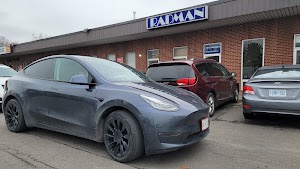
Located in Rexdale, Radman Auto Repair serves Tesla owners across Etobicoke, Toronto, Mississauga, Brampton, Vaughan, Woodbridge, Concord, North York, York Mills, Mimico, Richmond Hill, Markham, and the GTA for BMS error code diagnosis, Tesla battery warnings, and all other Tesla service needs.
| Toronto, Ontario | Etobicoke, Ontario | Mississauga, Ontario | Brampton, Ontario |
| Vaughan, Ontario | Richmond Hill, Ontario | Markham, Ontario | Weston, Ontario |